
Every fortnight or so we’ll bring you some technical updates that we feel you’ll find useful.
Today’s topics are the ACCC’s recent Digital Advertising Services Inquiry Interim Report, GroupM’s new Data Ethics Compass and an update on Apple’s forthcoming AppTrackingTransparency (ATT) privacy policy.
ACCC AdTech Inquiry – Interim Report
The interim report on the Digital Advertising Services Inquiry from the ACCC was released on Thursday last week and we’ve been reading through it ever since. Our first priority was to separate out all of the requests for further inputs in the form of proposals as well as the questions for stakeholders, as the deadline for responses is Friday 26th February 2021.
These have been summarised for our members and are available via the two links below:
– Questions for Stakeholders
– Proposals for Consultation
There are several proposals and questions that interest us particularly and we have been discussing with the relevant councils this week. Please find some of these below, along with a brief summary of the report’s content. The full report is available here
Key content in the report: other than the anti-competitive related content, the main general sections within the report are listed below.
Industry Background – supply chain, programmatic advertising & auction mechanics
Role of Data – collection, value and consumer impact
Industry Structure – overview of the landscape and key players
Vertical Integrations – largely in relation to potential conflicts of interest
Ad-Tech Pricing – mainly on fees, margins and levels of disclosure
Transparency – in relation to the operations, pricing and performance of Ad-Tech
Ad Agencies – no Government intervention is required for now, but recommendations for advertisers are provided in relation to contracts, transparency and audits
Some of the proposals we’re reviewing: there are six key proposals, all of which we will be reviewing with our councils over the coming weeks.
Two which immediately stood out are below:
Common Transaction ID – the implementation of a common transaction ID. Industry should implement a common system whereby each transaction in the ad tech supply chain is identified with a single identifier which allows a single transaction to be traced through the entire supply chain. This should be done in a way that protects the privacy of consumers.
Interestingly, there is a precedence for this concept and it is currently being reviewed by the IAB Tech Lab’s Programmatic Supply Chain Working Group.
Common User ID – the implementation of a common user ID to allow tracking of attribution activity in a way which protects consumers’ privacy.
Project Rearc is currently working towards creating a collaborative set of standards frameworks to enable any number of Universal ID’s to be made available and ensure that they are interoperable. To enable only one, in my personal opinion, would require it to be managed and overseen by a benevolent global non-profit.
Some of the related questions that we’re reviewing: there are about forty questions in total and a few listed below are related to the proposals previously mentioned. We are reviewing these with our relevant councils.
Does the use of user IDs and cookies in providing attribution services create privacy concerns?
Would a common transaction ID assist in making pricing and auctions more transparent?
What risks does a common transaction ID pose to user privacy?
Would a common user ID be an effective way to improve transparency in the ad tech supply chain?
Could these proposals be implemented practically and is it justified?
Could these proposals be implemented in a way which protects consumers’ privacy? If so, how?
Apple’s ATT Privacy Feature
28th January was Data Privacy Day and to mark the occasion Apple released A Day in the Life of Your Data document, detailing how third-party companies can track user data across websites and apps.
Within the document was also a vague timeline for the AppTrackingTransparency feature rolling out “…broadly in early spring with an upcoming release of iOS 14, iPadOS 14, and tvOS 14…“. As 14.4 is already out, this hints the mandatory policy being implemented within iOS 14.5 and onwards – most likely to be released before the end of March. Thereafter all iPhone, iPad, and Apple TV app developers will need to receive a user’s permission to track their activity across other apps and websites via their device’s advertising identifier (IDFA), for targeted advertising and to to measure campaign effectiveness.
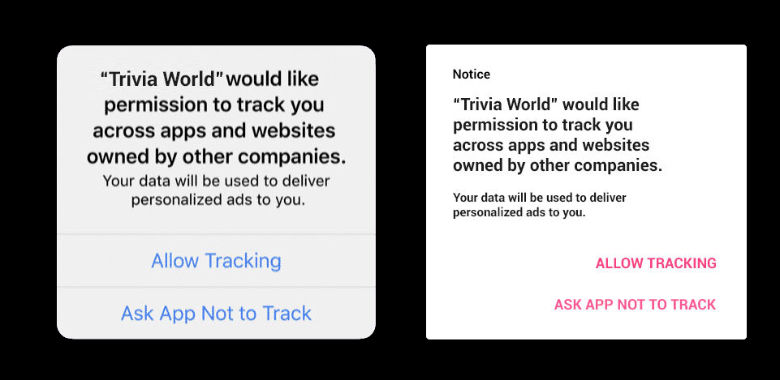
The requirement was initially scheduled to go into effect last September (click here for a webinar we ran at the time on this topic), however Apple delayed to give developers more time to prepare. The impact remains unclear, but early estimates based on user-polling are that at least 60% of iOS and Android users would deny tracking permissions if they are requested in-app to opt-in. Facebook has been especially outspoken on the topic recently and several vendors are already providing proactive guidance to their partners.
Additionally there are also very recent updates to both Apple’s Private Click Measurement (reviewed two weeks ago in this blog) and the SKAdNetwork (now on version 2.2). For more information on both updates please see here.
All of these activities are very heavy hints of the aggressive limitations to come in attempting to target, track and attribute campaigns to iPhone users. In order to prepare a key recommendation is to speak to your vendor partners and to also try and register with the SKAdNetwork API as an Ad Network now, if you have not already done so.
Further guidance from a previous post is here and the related OpenRTB technical specs are available here.
GroupM’s Data Ethics Compass
On a more positive note, we’ve seen an interesting product release recently from GroupM which could complement very nicely the current Data Transparency efforts with the Data Label initiative.
The intent of the Data Ethics Compass is to to incorporate ethical decision making into data-driven media buying so as to assist buyers by assessing the risk level of any data assets so that brands can make informed decisions before launching data-driven campaigns.
It only works as an advisory tool, guiding users through a dashboard showing risk levels and recommended actions – and brands will ultimately still have the final say. Any resulting high risk score would not prohibit the use of the data, but could indicate that the the client should give additional consideration about whether using the data is ethically sound.
I could see this or similar products working well alongside the Data Label and supporting the constructive advice and recommendations we and other industry bodies here in Australia try to provide the industry through the ADAPs (Australian Digital Advertising Practices).