
Connected TV is now one of the more important growth areas in Australia’s digital advertising market, spanning broadcaster BVOD services, global and local streaming platforms, and a growing set of other big-screen environments.
The most recent IAB Australia Internet Advertising Revenue Report shows that video advertising in Australia reached $5.4 billion in 2025, growing close to 20% year-on-year and continuing to take share of total digital spend. Within that, big-screen viewing across smart TVs, connected devices and streaming apps is where brand, retail and performance budgets are increasingly converging. For broadcasters, streamers and other big-screen environments, this is a structural shift. IAB Australia and Ipsos track Australian’s device usage and publish key information regularly in the Digital Landscape Report – the latest report shows that more than 22.5 million Australians aged 14+ are online each month, and 96% were online yesterday . Smart TVs are now in around 70% of households, sitting alongside smartphones and laptops as part of a genuinely multi-screen environment
A number of recent initiatives from IAB Tech Lab, alongside IAB Australia’s local frameworks and research, are aimed at improving how the market operates are outlined below.
Video Measurement Framework
What it is
Developed by IAB Australia, the Video Measurement Framework sets out how video performance should be assessed across delivery quality, brand impact and sales outcomes .
It outlines the key metrics used in each area and the methodologies that support them, including attention measurement, brand lift studies, attribution, incrementality testing and marketing mix modelling.
It is designed as a practical guide for how these approaches can be used together. Further detail on data requirements for MMM can be found in the detailed Market Mix Modelling Landscape Report published by the IAB Australia Ad Effectiveness Council.
Why it matters
Measurement expectations have become more complex. Campaigns are now assessed using a mix of delivery, brand and outcome metrics rather than a single measure. The framework provides a common reference point, making it easier to align reporting across campaigns and partners. This is particularly relevant as campaigns run across broadcaster BVOD, streaming platforms and other big-screen environments.
Video Format Matrix
What it is
The Video Format Matrix, developed by IAB Australia’s Video Council, maps how video formats operate across environments, including CTV, mobile and desktop.
It provides guidance on format characteristics, placement types and how creative can be adapted or reused across channels. It also highlights where formats align or differ across environments.
Why it matters
The matrix provides a clearer view of how formats align, allowing campaigns to be extended across environments with less rework.
CTV Ad Portfolio

What it is
In Q4 2024 IAB Tech Lab launched the CTV Ad Format Hero initiative to standardise the plethora of ad-hoc CTV ad formats that were being delivered by seeking creating submissions for review from across the industry.
From over 100 submissions a list of popular format types were identified and the industry surveyed on both the buy and the sell sides to understand the level of interest in each format and what opportunities for revenue, efficiency, and growth each format could potentially provide. Ultimately the list was narrowed down to six new ad formats (along with the already established linear ad format) which could be standardised for full adoption and specifications designed.
The final list is below and the initial specifications for each (click here) were published in Q4 2025:
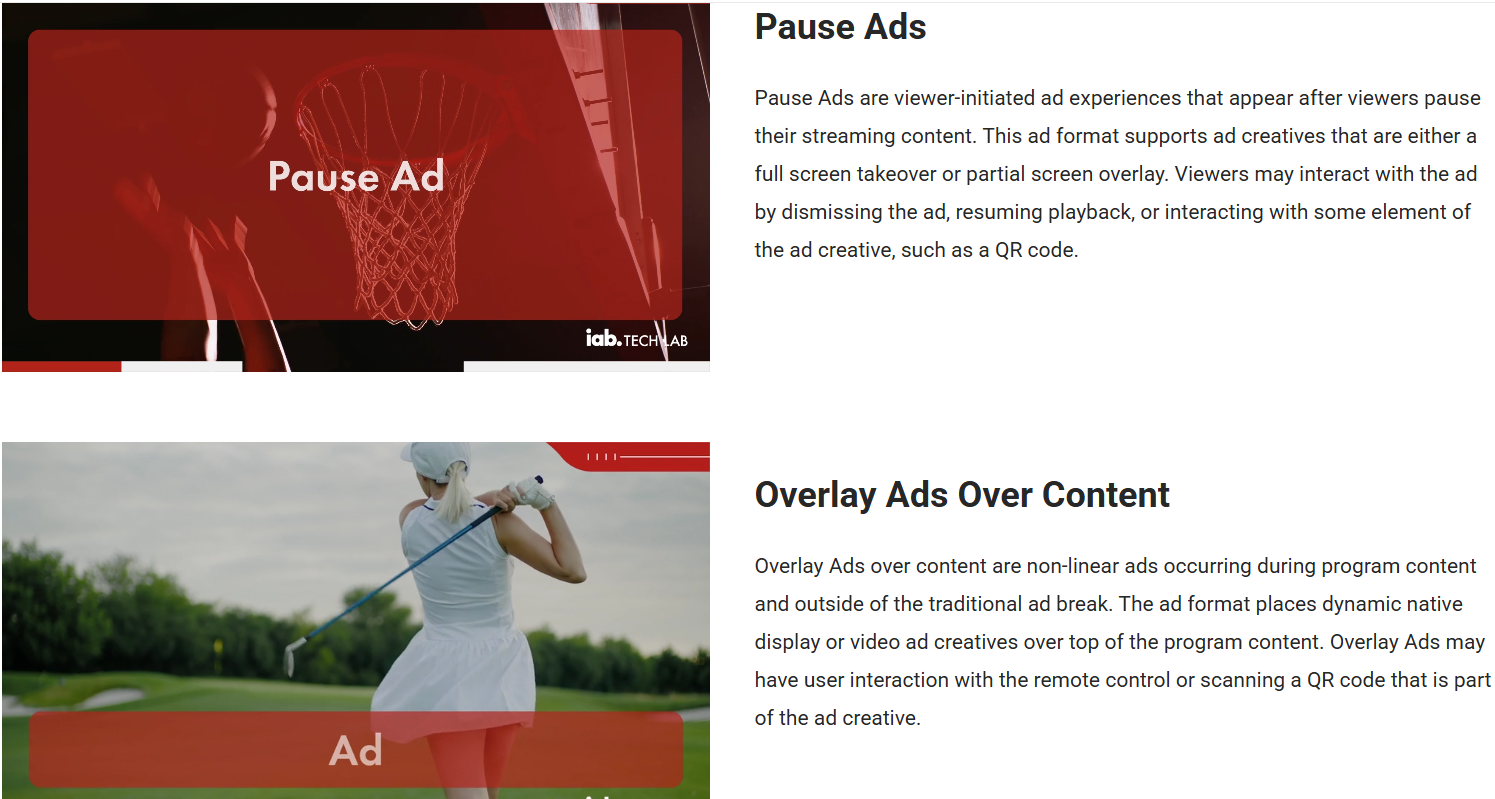
● Pause Ads
● Menu Ads
● Squeezeback Ads
● Overlay Ads
● In Scene Ads
● Screensaver Ads
Alongside this an update to the CTV Programmatic Guidance was released to support adoption.
Why it matters
Big-screen environments support a wider range of ad experiences than mobile or desktop. Without consistent definitions, buyers need to interpret each format separately. Standardised definitions make it easier to plan across broadcaster, streaming and other TV-based environments without treating each one differently. For sellers, this supports wider use of newer formats and reduces the need for custom setups.
Live Event Ad Playbook (LEAP)

What it is
Another key IAB Tech Lab project for CTV advertising through 2026 is the Live Event Ad Playbook (LEAP). LEAP is a series of technical recommendations and protocol enhancements aimed at enabling scalable, low-latency, and reliable ad delivery within live streaming environments.
There are 5 phases that will make up this set of standards:
-
- Concurrent Streams API: Enhanced data sharing with a near-real-time concurrent streams API
- Forecasting API: Apply live content signals in the bid stream (In public comment)
- Buyer Instructions API (Expected in 2026)
- Standardised ad pre-fetching: Manage bid request volume proactively (Expected in H2 2026)
- Creative Readiness: Streamline creative compatibility for live events (Expected in H2 2026)
Unlike many of the standards that IAB Tech Lab develops, the standards that make up the LEAP initiative interact with other standards to create a ‘workflow conversation’ between Buyer and Seller. Since many of these Live Events are high value inventory, they are often associated with Deals, so the Deals API comes into play, and then OpenRTB executes the transactions when the event actually occurs.
Why it matters
Big-screen environments support a wider range of ad experiences than mobile or desktop. Without consistent definitions, buyers need to interpret each format separately.
Standardised definitions make it easier to plan across broadcaster, streaming and other TV-based environments without treating each one differently. For sellers, this supports wider use of newer formats and reduces the need for custom setups.
OM SDK – Device Attestation

What it is
The Open Measurement SDK (OM SDK) is a long standing and well adopted industry-standard solution that enables enables advertisers and publishers to gain independent, unbiased measurement that works with multiple verification partners simultaneously – thereby verifying that their CTV, Mobile and online video ads are being seen by real people, viewable on devices, and delivering genuine value.
One area of fraud that has always been a ever-moving target to overcome is the challenge of device spoofing via the misrepresentation of device information. In premium ad environments this results in wasted ad spends for buyers, lost revenue for sellers and funding crime.
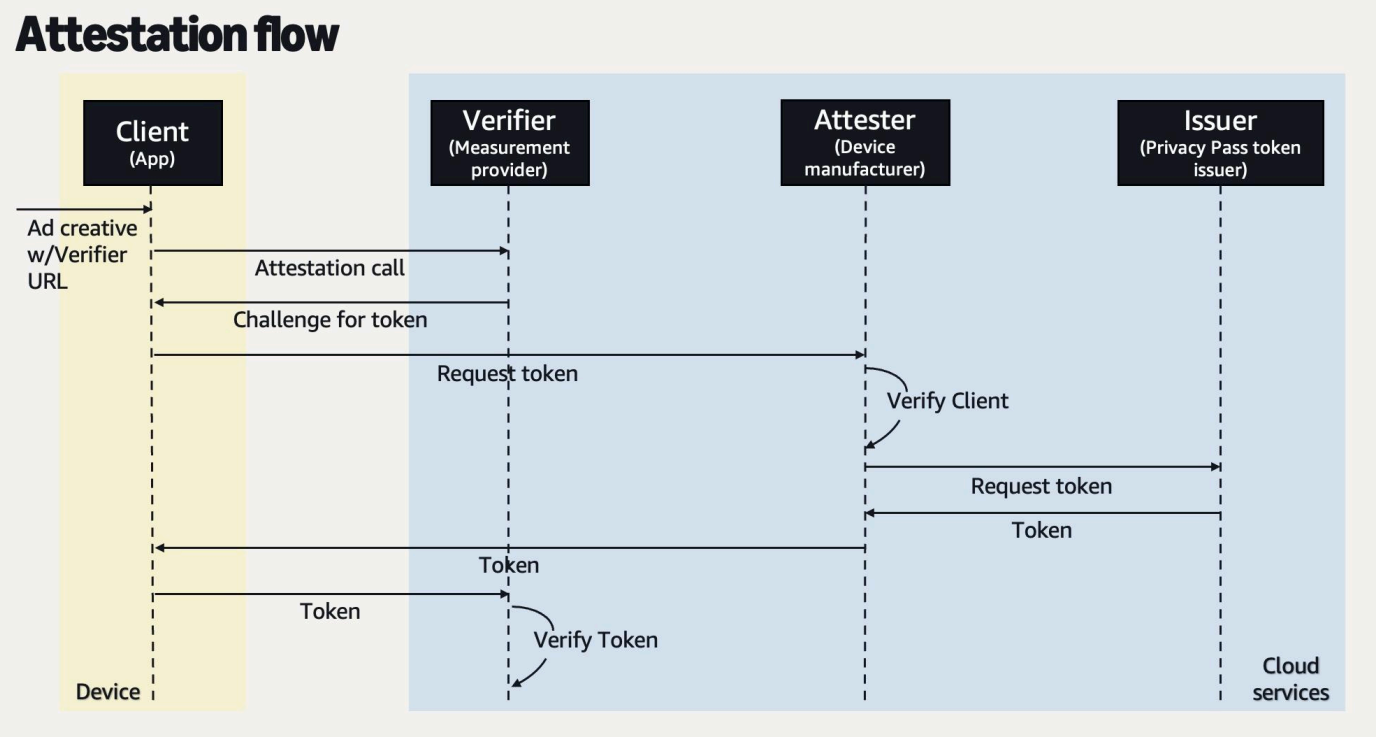
In November 2025 IAB Tech Lab released the device attestation feature for OM SDK – which allows manufacturers to confirm that ad impressions are genuinely associated with real devices resulting in industry having access to deterministic manufacturer-verified signals at scale, which are will always be more reliable than traditional probabilistic fraud detection approaches.
Locally we’ll be in touch with the seven Australian members that are certified for Open Measurement SDK and the various global verification vendors involved – to review and amplify the feature adoption and resulting benefits.
A visual flow of the new feature is below – and to review the implementation guidelines click here
Also, to review device fraud and many other examples of ad fraud and related best practices simply access our Ad Fraud Handbook here
Why it matters
Measurement in CTV has been affected by inconsistent access to signals, particularly in server-side environments. Device attestation addresses issues such as invalid traffic and device spoofing. This improves confidence in reported performance and supports more consistent verification across broadcaster and streaming environments.
CTV Programmatic Guide (IAB Tech Lab)

What it is
The CTV Programmatic Guide, developed by IAB Tech Lab, provides an overview of how a range of existing standards and approaches apply within CTV environments. It brings together guidance across OpenRTB, Open Measurement, SSAI workflows, identity, privacy and signal handling.
It walks through how these components interact across the full programmatic lifecycle, including bid request construction, signal passing, ad serving, verification and reporting. It also outlines how these processes differ between client-side and server-side environments.
Rather than introducing a new standard, it acts as a reference point for how current specifications and best practices fit together in CTV.
Why it matters
CTV implementation has varied across platforms, particularly in server-side ad insertion environments where signals can be incomplete or handled differently.
Bringing these approaches into a single view reduces interpretation and variation. It makes integration easier for buy-side platforms and helps sell-side platforms align their implementations.
For broadcasters, streamers and other big-screen environments, this supports more consistent execution and reduces the effort involved in managing different approaches across partners.
Video State of the Nation (IAB Australia)
What it does
The Video State of the Nation research, conducted annually by IAB Australia, provides a detailed view of how video is being planned, bought and measured in Australia. It covers areas such as format usage, data signals, campaign objectives, cross-screen strategies and measurement approaches. It also captures how agencies and advertisers are adapting to changes in the market.
Why it matters
The research shows that video is a significant part of campaign activity and that measurement approaches are becoming more layered. Delivery, brand and outcome metrics are all in use, but not always aligned. For broadcasters and streamers, this highlights the need to support multiple measurement approaches while maintaining consistency.

The 2026 Video State of the Nation will be released at the IAB Australia Video Summit on May 6 in Sydney.
Local digital video initiatves are driven by the 37 companies that are represented on the IAB Australia Video Council.